
When Mamma Mia! hit theaters in 2008, it wasn’t just a movie—it was a jubilant celebration of music, sunshine, and the sheer magic of escapism. Based on the hit stage musical, which itself drew from the timeless songs of ABBA, the film transported audiences to a sun-drenched Greek island where secrets, laughter, and love interwove seamlessly with some of the most iconic pop tunes of all time. Its success was no accident; the film carefully blended stunning cinematography, star-studded performances, and irresistible music to create a cinematic experience that was both emotionally resonant and endlessly entertaining.
A Star-Studded Cast Brings the Island to Life
At the heart of Mamma Mia! is Meryl Streep as Donna Sheridan, the independent and spirited owner of a small hotel on the Greek island of Kalokairi. Streep’s performance was a revelation for audiences familiar with her dramatic roles; she approached the musical numbers with a joyous abandon that made it clear she was having as much fun as the viewers. Her voice, while not traditionally pop-perfect, carried a raw authenticity that lent the songs emotional weight, making numbers like “The Winner Takes It All” both powerful and heartrending.
Opposite her, Amanda Seyfried shone as Sophie, Donna’s free-spirited daughter on the cusp of marrying the charming Sky, played by Dominic Cooper. Sophie’s innocence and yearning for familial connection created a poignant counterbalance to the adult complexities unfolding around her. Sophie’s journey to uncover the identity of her father provides the narrative spine of the film, and through her, audiences experienced the highs and lows of love, curiosity, and the longing for belonging.
Pierce Brosnan, Colin Firth, and Stellan Skarsgård played the three potential fathers—Sam, Harry, and Bill—each bringing his own distinct charm, awkwardness, and vulnerability to the film. The chemistry among these actors, often unexpected and delightfully comedic, helped anchor the story’s emotional core. Their musical numbers, though sometimes hilariously imperfect, embodied the film’s spirit: fun, messy, and full of heart.
The Greek Isles as a Character in Its Own Right
One of the most striking aspects of Mamma Mia! is its use of setting. The Greek island of Kalokairi is not just a backdrop; it becomes a character in the story. Shot on the real-life island of Skopelos, the movie captures the essence of the Aegean Sea with crystal-clear waters, whitewashed buildings, and winding cobblestone streets. Every scene is drenched in sunlight, creating a postcard-perfect vision of Mediterranean life that complements the music’s vibrancy.
Cinematography plays a critical role in making the island feel alive. Sweeping aerial shots reveal the rugged cliffs and shimmering coastline, while intimate close-ups of the tavern, the hotel, and narrow alleyways bring warmth and familiarity. These visual choices amplify the emotional stakes of the narrative: every stolen glance, dance, or confession occurs against a landscape that is as beautiful as it is transformative. The setting reinforces the film’s message that life, love, and music are inseparable from the environments in which they unfold.
ABBA’s Timeless Tunes Take Center Stage
Of course, no discussion of Mamma Mia! would be complete without its music. ABBA’s songs are the lifeblood of the film, carefully woven into the narrative so that they feel organic rather than forced. Hits like “Dancing Queen,” “Mamma Mia,” and “Take a Chance on Me” are not just performances; they are expressions of character, mood, and story.
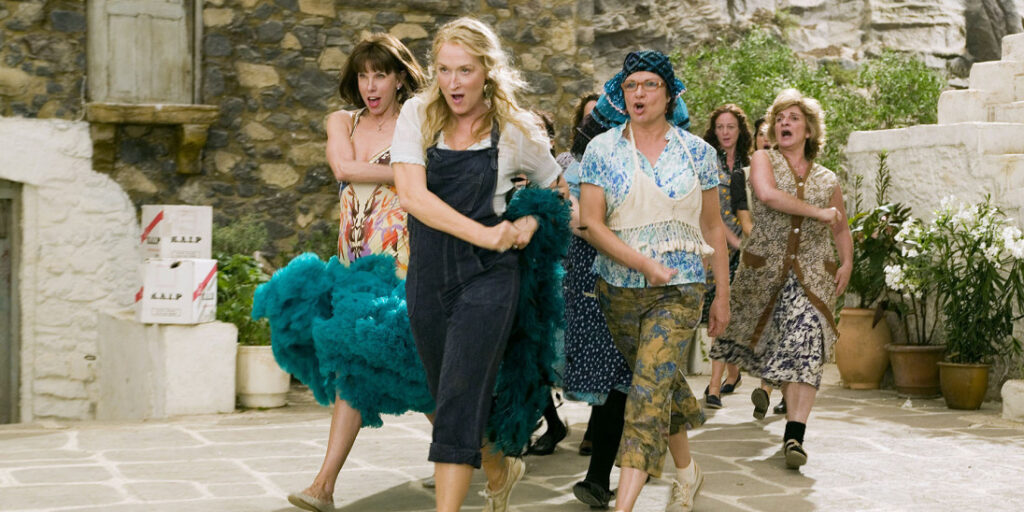
“Dancing Queen,” performed by Donna and her friends, Rosie and Tanya, is a jubilant declaration of freedom and self-expression. Streep’s performance, along with Julie Walters as Rosie and Christine Baranski as Tanya, is playful yet heartfelt, showing that joy can be found even amidst uncertainty. Meanwhile, Sophie’s renditions of songs like “I Have a Dream” express hope and longing, underscoring the universal themes that have made ABBA’s music endure for decades.
The filmmakers understood that the key to adapting a stage musical for the screen was to maintain the emotional resonance of the songs while leveraging cinematic techniques. Camera angles, choreography, and location were all carefully considered to elevate the musical numbers. A dance across sunlit cliffs or a heartfelt solo in a candlelit room becomes more than a song; it becomes a cinematic event, a moment that lingers in the audience’s mind long after the credits roll.

Love, Family, and the Power of Music
At its core, Mamma Mia! is a story about love in its many forms. Romantic love, maternal love, and the love between friends all intersect, creating a rich tapestry of human emotion. Sophie’s quest to discover her father’s identity drives much of the plot, but the film also explores the complexities of relationships among the adults. Donna’s past romances with Sam, Harry, and Bill are tinged with nostalgia, regret, and enduring affection, reminding audiences that love is rarely simple but always worth celebrating.
Music serves as the connective tissue for these relationships. Each song is carefully placed to reflect the emotional state of the characters, whether it’s the exuberant joy of “Mamma Mia” when Sophie learns of her potential fathers, or the bittersweet melancholy of “The Winner Takes It All” as Donna confronts unresolved feelings with Sam. ABBA’s music allows the audience to feel what the characters feel, creating a sense of intimacy and immediacy that few non-musical films can achieve.
Humor and Heart in Equal Measure
One of the most remarkable achievements of Mamma Mia! is its ability to balance humor and emotion without ever feeling forced. The comedic timing of Pierce Brosnan stumbling through “SOS,” or the awkward tension between the three potential fathers, provides levity that keeps the story lighthearted and entertaining. At the same time, moments of vulnerability—Donna’s reflections on her single motherhood, Sophie’s uncertainty about her future—lend the film emotional weight.
This blend of comedy and heart is part of what has allowed the film to resonate with audiences across generations. Whether viewers are coming for the catchy tunes, the picturesque scenery, or the charming performances, they leave with an appreciation for the deeper themes of connection, resilience, and joy.
Choreography and Dance as Storytelling
Dance in Mamma Mia! is never incidental. Every step, twirl, and jump tells a story, often conveying what words cannot. The film’s choreographers used movement to express emotion, create tension, and highlight relationships. For instance, the ensemble dance sequences are exuberant celebrations of community, friendship, and youthful energy, while solo dances allow characters to reveal inner desires and fears.
The joy of watching these sequences is amplified by the Greek setting. Sunlit courtyards, sandy beaches, and cliffside terraces become stages, making every dance feel spontaneous and authentic. The choreography’s combination of theatricality and naturalism mirrors the film’s broader aesthetic: larger-than-life musical numbers grounded in a believable, tangible world.

Cultural Impact and Lasting Legacy
Since its release, Mamma Mia! has left an indelible mark on both cinema and popular culture. It introduced a new generation to ABBA’s music, reinvigorated interest in musical films, and inspired countless audience members to sing and dance along. The film’s success also led to the 2018 sequel, Mamma Mia! Here We Go Again, which explored the backstories of beloved characters while maintaining the same infectious energy.
Beyond the box office, Mamma Mia! has influenced tourism in Greece, as fans flock to Skopelos and nearby islands to experience the film’s locations firsthand. Its joyful depiction of life, love, and music has transcended cultural and geographic boundaries, proving that the combination of story, song, and setting can create something truly universal.
Conclusion: A Celebration of Joy and Music
Dancing Through the Greek Isles: How Mamma Mia! Brought ABBA’s Music to the Big Screen is more than a tale of adaptation; it’s a celebration of the transformative power of music and cinema. Through memorable performances, stunning locations, and a soundtrack that continues to resonate decades after its release, the film captures the essence of joy, love, and human connection.
From Donna’s spirited independence to Sophie’s hopeful curiosity, from Sam, Harry, and Bill’s awkward charm to the breathtaking beauty of the Greek landscape, every element of Mamma Mia! works in harmony. ABBA’s songs, infused with emotion and cinematic flair, become both the heartbeat of the story and a shared experience for audiences around the world.
In the end, Mamma Mia! is a reminder that life is best celebrated with music, laughter, and a little bit of dancing, ideally on a sun-soaked Greek island. It’s a film that invites viewers to sing, to feel, and to believe in the joy that comes from connection, whether through family, friends, or the universal language of a perfect song.